Resist The Technocrats


by Jan Eijking
July 31, 2026
from AEON Website
| Jan Eijking is a researcher in international relations working on expertise, empire, and capitalism in the history and theory of international organizations. He is currently a Marie Skłodowska-Curie Fellow at the University of Antwerp in Belgium. He is the author of ‘The Technocratic International: Experts and the Making of a World from Nowhere‘ (2026). |

UN secretary general António Guterres
and his entourage, New York City.
Photo by Mark Henley/Panos
Through international organizations,
they wield power under the pretence
of simply following the experts.
Don’t believe them…!
In 1865, delegates from 20 countries – at the time, a category so broad it included both the Ottoman Empire and the Free City of Hamburg – gathered in Paris to establish what would become the International Telegraph Union.
The task before them was as technical as it was consequential:
to standardize signaling systems so that messages could cross borders without delay or distortion.
Regional agreements had already brought some uniformity to European overland telegraph lines.
Now, this infrastructure was to be unified at the scale of the world.
Historical black and white photo of a group of men in formal attire, seated and standing, against a plain backdrop.

Delegates to the 1865 conference in Paris
that formed the International Telegraph Union
Politics, the participants insisted, had no place at their gathering. Telegraphy was a matter of wires, codes and efficiency:
of electrical, not political, power.
As the French senator and conference president Édouard Drouyn de Lhuys put it in a speech to the delegates, if ‘war often arises from misunderstandings’, then ‘to facilitate the exchange of ideas between peoples’ along ‘this electrical current on which thought flies through space’ was to remove one of its causes.
The work of the ‘elite men’ gathered in Paris, he suggested, might render political strife itself obsolete.
Yet the telegraph lines to be harmonized had already proven their immense worth as instruments of empire, military command and commercial domination. And so, in Paris, decisions about standards favored certain firms, certain states and certain routes of transit.
Claims to technical neutrality did not suspend existing power imbalances. They rearticulated them on regulatory terms.
This logic has become a staple of international relations since. From lending bodies to public health agencies, international organizations continue to use technical experts – whether economists or medical scientists – not just to understand and solve problems, but also to present themselves as havens above the fray of strife and rivalry, residing in a sphere where evidence makes policy.
Based on this, they tend to insist on their innocence.
When funding pressures arise, geopolitical gridlock looms or populists push back, these forces are almost always referred to as external.
Thus, when the former diplomatic chief of the European Union, Josep Borrell, in 2022 referred to non-Europe as a ‘jungle’, he invoked colonial imagery – but also a flattering view of the EU as a shelter from the storm.
The price to pay for this kind of denialism is painfully clear today, as the EU is forced to redefine its role in world politics…
The English philosopher Jeremy Bentham in 1782 wrote of international law that it would ‘soar above the mists of prejudice’.
The same vision underpins international organizations, and claiming this position is a key source of their legitimacy.
For some, like the International Committee of the Red Cross, it can be a necessary condition for doing their work.
For others, like the International Monetary Fund, the claim is easily discredited once, say, the political side-taking involved in imposing austerity comes into view.
Yet in either case, international civil servants do not in fact escape power. They rearticulate it with the help of technical experts.
By framing this rearticulation as real impartiality, however, they conflate technocracy and expertise. This conflation lies at the heart of the legitimacy crisis that international organizations face today. To deal with that crisis, we thus need to disentangle the two.
Only then will we be able to focus on the core problem:
not expertise, but the technocratic use of expert advice.
To save expertise, we need to resist technocracy. In the case of international organizations, this requires that we demythologize their origins, that we acknowledge they have never been independent from politics, and that we refrain from technocratic wishful thinking.
International organizations are often described as spaces where diplomatic exchange enables agreement on how to tackle shared problems.
To best understand and solve a given problem – an emerging public health hazard, the potential risks of a new technology, the acceptable threshold for military intervention – the staff of international organizations recruit experts, whether virologists, economists or lawyers.
This is where the trouble begins:
Who counts as a recognized expert?
Which areas of specialization are considered relevant for which problem?
And based on what criteria do they get selected: their university degrees?
Citation count?
Media engagements?
Prior contributions in a similar capacity?
When the COVID-19 epidemic hit, for example, the World Health Organization (WHO) assembled an Emergency Committee, chaired by the French government’s former director general for health, Didier Houssin.
Members of this committee were representatives of 13 WHO member states. All of them had doctorates; some of them were delegates of their public health ministries; others were university professors.
An additional advisory board included representatives of other organizations, such as the International Maritime Organization and the International Civil Aviation Organization. In short, at every stage, mobilizing these experts involved choices to prioritize some selection criteria over others.
Expert selection is always imperfect.
But focusing on the experts alone is not enough:
generally speaking, it is their mobilizes who make policy.
These technocratic mobilizes, usually international civil servants, use experts to develop policy that is impartial, evidence-based, expert-approved.
Even if occasionally, some of the latter speak in the name of the former, there is a real difference:
technocrats and experts are not the same.
Despite that, both organizations and their critics rarely distinguish expertise as such from the technocratic logic that assigns its place in politics.
The facile declaration in 2016 from Michael Gove, a British conservative politician,
that ‘the people in this country have had enough of experts’ was wrong,
…but not because he undermined the authority of scientists, many of whom reacted with an outcry.
In reality, Gove had confused the bathwater with the baby. He later clarified, however unconvincingly, that he never meant to reject ‘facts, evidence, rigor’, but rather particular people from particular organizations.
What people had ‘had enough of’ was not experts – but technocrats.
The UN’s legitimacy
can hardly hinge on endlessly repeating
the mantra of expert impartiality…
This conflation haunts, and often blinds, international organizations to this day.
The complications of getting the right experts on board are one thing. Turning the fact that expert advice has been consulted into an institutional identity writ large raises a whole other set of questions. When IMF conditionality gets justified on the basis of scientific models, developed by world-class economists, this inevitably looks like experts taking sides – when in fact it was their technocratic mobilizes who did.
Entirely apart from the question of whether these economists were the ‘right experts’, or had some political motives attracting them to the IMF in the first place, the question we need to ask is thus:
what happens to the public perception of expertise when technocratic organizations claim to speak in its name?
This question is intimately connected to the founding rationale of modern international organizations.
A substantial part of their authority is widely understood to derive neither from popular will nor from coercive force. It derives from a claim to superior knowledge:
knowledge of how trade should be regulated, rivers governed, diseases managed or currencies stabilized.
Expertise somewhat automatically generates authority.
This institutionalized vision continues to anchor the legitimacy of international organizations today. But its implicit complacency can become pathological. When international organizations receive pushback, their representatives often respond by stressing the basis of their work in evidence.
At the height of the COVID-19 ‘pandemic‘, the UN secretary general António Guterres thus told the 75th General Assembly that, in the face of the,
‘populism and nationalism’ that had driven vaccine competition, ‘we must be guided by science and tethered to reality.’
But if ‘science’ is not a singular thing that we can simply plug into policy-making,
what do such remarks really do?
Of course, some of the criticism of the UN system may well be motivated by political point-scoring rather than grievance. But the UN’s legitimacy can hardly hinge on endlessly repeating the mantra of expert impartiality.
Such statements suggest a sharp division between politics and expertise that is aspirational, not real. Public commentators and scholars have long noted that much. What follows from it is less clear.
Can expertise still generate self-evident authority if it is so hard to mobilize, yet so easy to simulate?
‘The experts are terrible,’ said Donald Trump during his 2016 campaign for the US presidency, yet today his administration simply plays a game of bring-your-own-expert.
At the international level, distrust easily remains even on ‘expert issues’, as it did when commentators accused the WHO of being ‘China’s coronavirus accomplice’.
So then,
is expertise irredeemably compromised by its political uses?
And is insisting on the difference between technocracy and expertise yet another way to artificially separate expertise from politics?
To answer these questions, we need to retrace technocratic visions of international cooperation further back.
Rather than start from the 1945 establishment of the UN system, or its short-lived but consequential predecessor, the interwar League of Nations – crucial moments in the history of international relations though these were – we need to turn to a period when fully fledged technocratic international organizations first became a reality:
the middle decades of the 19th century.
In the early 19th century, political thinkers such as Jeremy Bentham or Henri de Saint-Simon had popularized the idea that impartial institutions with a mandate across national borders were essential to building a harmonious world order.
In different ways, both had made the case for international institutions led by scientists and engineers – in one essay, Saint-Simon had proposed a ‘council of Newton’ dedicated to the ‘progress of the human spirit’ that could unite rivalrous nations upon the common ground of scientific facts.

Posthumous portrait of
Henri de Saint-Simon (1848)
by Hippolyte Ravergie.
Courtesy BnF, Bibliothèque de l’Arsenal/Wikipedia
Inspired by such radical proposals, Europe’s international organizers of the 1850s and 1860s experimented with, and gradually built, their own expert-centered institutions.
Many of these innovators, including Saint-Simon and his numerous disciples, had received their education at the same prestigious institutions as the experts they wished to recruit:
- in the case of France, the École Polytechnique was the core hub for such projects
- in England, private schools and the universities of Cambridge and Oxford, but also gentlemen’s clubs, played a similar role…
Early efforts at international organization-building were thus, respectively, dominated by French engineers, British lawyers and political economists hailing from both sides of the Channel.
One reason why today we conflate experts with technocrats may be that, historically, they did belong to the same fledgling transnational elite.
Yet, crucially, these same individuals were also servants and beneficiaries of the imperial global order. That order, of course, was responsible for the divisions and inequalities their new organizations were supposed to overcome. How did they square this deep contradiction?
Answering this question requires two things.
First, once again, it requires that we take care to distinguish technocracy from expertise:
justifications of technocratic authority rely on claims about expertise and scientific evidence, as opposed to claims about, say, democratic representation.
Technocracy, short of literal rule by experts, then constitutes a style or mode of politics that mobilizes and thus uses (or abuses) expertise.
Think of the Troika of the European Commission, the European Central Bank and the IMF that managed the bailouts of Greece, Cyprus, Portugal and Ireland after the 2008 financial crisis:all three institutions justified their harsh and controversial interventions across these countries by reference to economic expert advice.
This allowed them to sidestep democratic deliberation as well as, most controversially, accountability.
The crux is that experts and their technocratic mobilisers are different sets of actors with different motivations:
- the former translate their credentialed specialist knowledge into advice and recommendations
- the latter try to persuade us that they simply follow that advice
International organizationsinvented a technocratic international
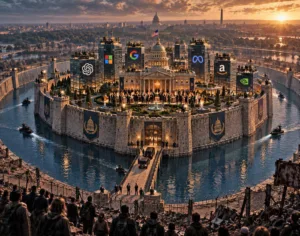
that was not unlike a gated community…
Second, we have to understand that the most ardent supporters of ‘independence from politics’ have, historically, been those setting the terms of its inverse.To ‘soar above the mists of prejudice’ often was the privilege of none other than the mist-makers. Freedom from power comes easy when you wield it yourself.
This is how we should approach the mid-19th century’s international organizers:
as high-minded winners in a world of empires.
It is no coincidence they pitted their projects precisely against both the prejudiced mob and the rivalries of an old system of power politics.
Saint-Simon and his collaborator (and later famous historian) Augustin Thierry thus explicitly contrasted their 1814 proposal for an ambitious ‘Mediterranean union’ with the old Westphalian ‘political operation that is called balance of powers’. In the latter’s stead, they argued, ‘common institutions are needed, an organization is needed’ or else ‘everything is decided by force’.
What is often overlooked is that Saint-Simon, his influential disciples, as well as Europe’s international organizers more broadly had decidedly European clubs in mind when they thought of international organizations.
Saint-Simon explicitly excluded African and Asian membership in his various proposals for expert-led international councils, for instance, based on his deeply prejudiced views about ‘civilisational’ and racial difference.
The making of international organizations, then, was not insulated from imperial expansion, multinational business interests or great-power competition. On the contrary, many of the organizations we today praise as great but tragically ailing bulwarks against power politics have historically been the latter’s fellow travellers.
Their claim to neutrality did not restrain power; it normalized it, and it often did so by fiat. International organizations invented a technocratic international that was not unlike a gated community:
sheltered from its own conditions of existence.
This much becomes clear, anyhow, once we move beyond celebratory origin stories.
The UN system, like the EU, is often credited with rebuilding global order from the ashes of war – learning from the failures of the League of Nations, facilitating decolonization, and replacing ideological conflict with functional cooperation.
Far from it…
As historians like Susan Pedersen or Mark Mazower have shown at length, the UN’s relationship to empire was far more accommodating. At the height of anticolonial struggle across the globe, the UN was no enabler of emancipation, but an administrator of imperial rule, euphemistically transformed into international trusteeship and mandated territories.
As soon as we go still further back in time, it becomes clear that international organizations did not arise as a response to the 20th century’s catastrophic world wars, but in close tandem with 19th-century capitalist and imperial expansion – to which they ended up being indispensable.
Long before the League or the UN, they were first invented to administer, standardize or oversee transnational railways, telegraphs, rivers, postal networks. These bodies – like the International Telegraph Union that emerged from that 1865 conference in Paris – gradually became permanent commissions and ‘public unions’.
They all framed their work as primarily if not purely technical, even as they operated in, for and at the mercy of a world structured by empire, industrial monopoly and great-power competition.
By the early 20th century, devising technical-scientific answers to complex political problems had become a standard feature of international politics.
What theorists and advocates of European integration, most famously David Mitrany, later conceptualized as ‘functionalism’ – cooperation over technical rather than ideological common ground – has been a remarkably persistent feature and, not least, served as the founding rationale of the EU.
Even within these institutions, however, not everybody agreed with the glib optimism of the technocratic internationalists.
In 1940, members of the League of Nations Economic and Financial Organization, then in exile at Princeton University, warned against replacing political dictatorship with,
‘a new dictatorship of scholars’.
Expertise, these economists recognised, could never substitute for democratic authority.
‘In the democratic world,’ they stressed, ‘the final power must always rest with the mass of people, with laymen.’
The experts themselves, in this case, were wary of the technocratic temptation.
International organizations,
we are told, are ‘under fire’.
But it is a fire of their own making…
And yet, the post-1945 moment did not break with the technocratic style so much as repackage it.
After two world wars, the UN reinvented international organizations as guardians against catastrophe, emphasizing peaceful collective action, mutual trust and sovereign equality under international law. Confidence returned, and international organizations proliferated.
Simultaneously, though, Cold War rivalry, developmental hierarchies and the priorities of advanced industrial economies were firmly built into institutional mandates and decision-making structures.
As in the 19th century, technocrats once again used expert mobilization as a way not only to ‘solve problems’ but also to deflect away from the political consequences of their work.
This historical logic, and the tension it generates, remains central today.
For decades, critics across the political spectrum have called out international organizations for being run by and for global elites. Left-wing activists from Seattle to Buenos Aires targeted IMF austerity programs as neocolonial curtailments of economic sovereignty. Right-wing movements have attacked the EU for putting farmers out of business.
These conflicts are often framed as clashes between irrational publics and well-meaning institutions; as a matter of ‘bad information’.International organizations, we are told, are ‘under fire’. But it is a fire, at least in part, of their own making:
as inherently elitist projects, they have consistently pitted politicized masses against apolitical expertise.
In the long run, denying this reality is self-undermining. Technocratic internationalists compound their own plight by either denying or externalizing political demands.
Taking the pathologies of technocracy more seriously is not just a matter of conceptual accuracy. The stakes are much higher. At this year’s World Economic Forum (WEF) in Davos, a room full of investment bankers, diplomats and journalists gave a standing ovation to the Canadian prime minister Mark Carney putting nails in the coffin of the ‘rules-based international order’.
Ironically, it took that order’s own embodiments – a former central banker, and an audience of technocrats – to hammer them in.
Are we witnessing the end of the technocratic international…?
Built and maintained by those who had most internalized the technocratic style, the rules-based international order had always been understood to reside in organizations like the UN agencies, the EU, the African Union, the Association of Southeast Asian Nations.
Of course, this order had already undergone transformation. Since the end of the Cold War, new sites of international cooperation – the Shanghai Cooperation Organization, founded in 2001, or the Asia-Pacific Economic Cooperation forum, established in 1989 – have signaled shifting centers of gravity.
But, by and large, these institutions reproduced the technocratic style rather than replacing it.
Several months after staff redundancies drew controversy among UN staff, Guterres said the UN’s financial crisis is getting to the point of putting program delivery at risk; funds could dry up by this July. Now, according to its chief, the UN is facing the risk of an ‘imminent financial collapse’ given mounting arrears in membership dues.
Eighty years after its founding,
is the UN system dying – and the technocratic style of world politics with it…?
International organizations
cannot retreat to a space beyond power,
because no such space exists…
Since Trump launched his Board of Peace, lingering worries about defunding and institutional fragmentation have certainly turned more tangible.
The notion of populist pushback, then, no longer adequately captures what’s happening – if it ever did.
The EU has recently rolled back climate regulations under the spell of Right-wing fossil-fuel enthusiasts; and campaigns for the DOGEification of the UN are already underway.
We have come a long way from mere pushback:
the anti-globalists are in power, but rather than reject multilateralism they repurpose it.
We should not be too quick to assume that the technocrats will disappear, however.
As the political scientist Jens Steffek argues, technocratic internationalism is ideologically highly flexible.
Any part of the political spectrum can engage, and in the past has engaged, in technocratic expert mobilization.
If this holds true, and if we want to retain some space for expert input in international affairs,
resisting technocracy will become only more important…!
To do so, we need to accept that international organizations were never as separate from political turmoil as they claimed.
While they were portrayed and, after a while, treated as expert-driven vehicles of technical cooperation, they facilitated and protected the unequal global order they had sprung from. Today, they need to abandon the denialism they were founded upon.
International organizations cannot retreat to a space beyond power, because no such space exists. What they can do is shape how power is exercised, justified and contested.
To this day, international organizations tell us that they can solve problems with science, and when push comes to shove, well-meaning experts are the targets of blame and resentment.
Defenders and critics still talk past each other. Yet by treating pushback as anti-expertise or anti-science, we risk denying actually important redistributive demands and thus miss a chance for international organizations to gain rather than further lose public trust.
The real challenge, then, is whether we can rethink international organizations and rethink the place of expertise in them.
Disentangling technocracy from expertise is one step in that direction, because it clarifies what the target of critique is and should be:
not ‘the experts’ but knee-jerk reliance on the depoliticizing force of expertise; not ‘science’ but divisive political interventions carried out under its cover.
Technocratic uses of expert advice, aimed primarily at sidestepping public accountability and deliberation, are a real problem that we need to not downplay, but face head-on.
If we don’t, we condemn international organizations to subversion, substitution or irrelevance…